

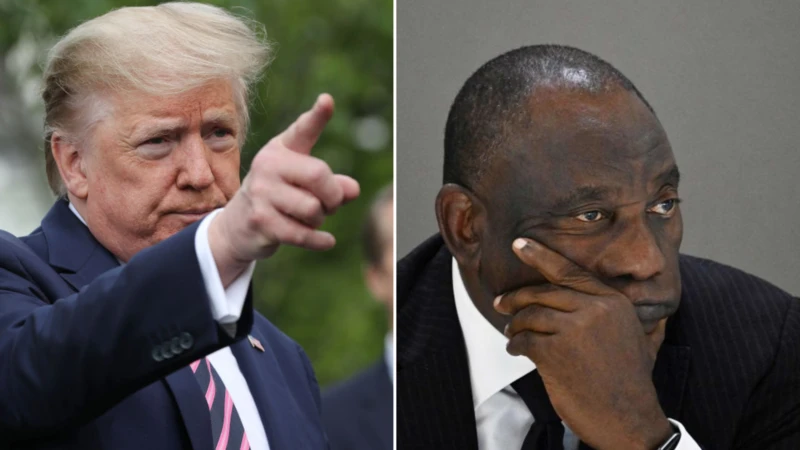
President Donald Trump has announced that South Africa will not be invited to the 2026 G20 summit in Miami, escalating tensions that began when the US boycotted last week’s first-ever G20 meeting held in Africa.
The controversy arose during the formal handover of the G20 presidency from South Africa to the United States on Monday. Traditionally, this transfer occurs between heads of state, but President Cyril Ramaphosa declined a last-minute request to hand over the presidency to a US diplomat, prompting Trump to take the unprecedented step of excluding South Africa.
“Therefore, at my direction, South Africa will NOT be receiving an invitation to the 2026 G20, which will be hosted in the Great City of Miami, Florida next year,” Trump wrote on Truth Social. He added, “South Africa has demonstrated to the world they are not a country worthy of membership anywhere,” and announced that the US would immediately halt all payments and subsidies to the country.
South Africa rejected the move, insisting it would still attend the summit. Ramaphosa stressed that the country holds its G20 membership “in its own name and right” and that its participation is recognized by other member states. The presidency added, “South Africa is a sovereign constitutional democratic country and does not appreciate insults from another country about its worth in participating in global platforms.”
The dispute comes amid Trump’s repeated claims — widely disputed — of a “genocide” of white farmers in South Africa, which he has cited in criticism of the nation. The South African presidency described his actions as “regrettable” and “based on misinformation and distortions,” noting that Ramaphosa had made repeated efforts to reset diplomatic relations.
Tensions escalated further when Washington revoked the visa of Naledi Pandor, a former South African foreign minister, shortly after Ramaphosa refused the US request regarding the G20 presidency handover. At last week’s summit, Ramaphosa successfully guided the remaining 19 members in signing a joint declaration, despite Trump’s demand that no statement be issued.
Analysts warn that Trump’s exclusion could have broader economic implications. Chris Hattingh, executive director of Johannesburg’s Centre for Risk Analysis, said: “There is a risk that the US will pressure other countries to weaken their trade, investment, commercial and diplomatic links with South Africa, lest they also be pushed out of the G20.”
Despite the political tensions, US businesses continue to engage with South Africa. At the B20 business track of the G20, representatives from JPMorgan, Visa, and Citi signed a joint statement with South African counterparts to strengthen commercial ties. Gary Litman, the US business sherpa, said the objective is to ensure political leaders create an environment that allows companies to pursue business goals.
The development highlights the deepening friction between Washington and Pretoria, emphasizing the complex intersection of diplomacy, politics, and global trade ahead of next year’s Miami summit.