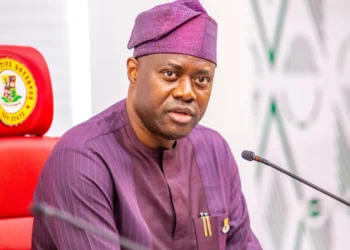
The newly appointed service chiefs, announced by President Bola Tinubu last weekend, were confirmed by the Senate yesterday. During the confirmation session, the new Chief of Defence Staff (CDS), Lieutenant General Olufemi Oluyede, urged the Federal Government to provide the Police with adequate funding to enable the force to handle internal security duties and allow the military to focus on its constitutionally assigned responsibilities.
He also called for sufficient funding for the Armed Forces to effectively combat terrorism, stressing that the government should prioritise the local production of military equipment, as dependence on imports is not sustainable.
The new CDS, who previously served as the Chief of Army Staff (COAS), made this appeal while the Chief of Naval Staff, Rear Admiral Idi Abbas, opposed the proposed creation of the Coast Guard, arguing that it would overlap with the functions of the Navy.
Meanwhile, the newly appointed Chief of Army Staff, General Waidi Shuaibu, vowed to take firm action against the Lakurawa sect, which has been responsible for terror attacks in several northern states.
Others confirmed by the Senate included Rear Admiral Idi Abbas as Chief of Naval Staff and Air Marshal Sunday Kelvin Aneke as Chief of Air Staff.
Their confirmation followed a motion moved by Senate Leader Opeyemi Bamidele (APC, Ekiti Central), who asked his colleagues to consider the President’s request for approval of the nominees in line with Section 18 (1) of the Armed Forces Act.
Senator Bamidele further proposed that since the Senate had previously screened and cleared Oluyede for the position of Chief of Army Staff, there was no need for another screening.
However, the Senate President, Godswill Akpabio, overruled this, explaining that since Oluyede was being appointed to a new role, he needed to address the senators regarding his background, career, and experience.
During his screening, General Oluyede, who detailed his over three decades of military service and numerous professional qualifications, described his time as Chief of Army Staff as challenging but noted that insecurity in Nigeria had significantly decreased during his tenure.
He emphasised that the military required greater support from citizens and additional resources, lamenting that inadequate funding was hampering the fight against terrorism.
He said, “I believe the police need to be restructured and strengthened. Many of the internal security duties currently handled by the military rightly belong to the police.
“Empowering the Nigerian Police Force will allow the Army to focus more on external defence and counter-terrorism operations.
“The fight against insecurity requires a whole-of-society approach. Security should not be left solely to the Armed Forces. Every citizen, institution, and community has a role to play in making Nigeria safer.”
On managing information, General Oluyede said, “It requires cognate experience, sleepless nights, and total dedication to the safety of our nation.
“We all know resources are limited, but Nigeria must build its own capacity to confront emerging security threats from terrorism to cybercrime. If we fail to manage information effectively, our challenges will persist.”
He stressed the need to enhance local defence capabilities and develop homegrown solutions to national security problems.
After his screening, several senators commended General Oluyede for his leadership and efforts in addressing insecurity.
Before inviting him to speak, the Senate President, Godswill Akpabio, praised his service record, recalling that Nigerians had celebrated his earlier appointment as Chief of Army Staff due to his reputation as a frontline officer.
Akpabio said, “You are not a general who sits in the office; you have been in the theatre of warfare, serving the nation meritoriously. Since you assumed office, there has been no part of Nigeria where the Boko Haram flag has been hoisted.
“You have reduced attacks to isolated incidents and saved the nation from countless threats. We are proud of you.”
Rear Admiral Idi Abbas, while addressing the Senate, opposed the proposed establishment of the Nigerian Coast Guard, which would be responsible for securing the country’s maritime zones.
He argued that creating such an agency would duplicate the functions of the Navy and suggested that the funds intended for the new body be allocated instead to the Navy.
Rear Admiral Abbas said, “Establishing a new agency is not necessary and will amount to duplicating functions.
“We don’t need a separate coast guard because the Nigerian Navy already performs those functions. Creating another agency would duplicate efforts. It’s better to channel those funds toward boosting naval operations,” he said.
Addressing the issue of oil theft, Abbas noted that the problem was prevalent in difficult-to-access areas.
“The theft may appear minimal individually, but when accumulated, it becomes substantial. We’re exploring drone technology to monitor and plug these leakages,” he said.
He added, “We will incorporate more technology, including the use of drones, to tackle maritime crime.
“A lot of resources are currently wasted fueling boats to reach remote areas. Technology will help us respond faster and more effectively.”
On the issue of security along inland waterways, Abbas revealed the existence of a Special Operations Command in Makurdi, Benue State, designed to protect the Benue–Lokoja corridor and other routes.
Regarding the reintegration of repentant insurgents, he emphasised a humane, community-based approach, saying, “Families who lost loved ones must be consulted and counselled before amnesty is granted. That fosters healing and community acceptance.”
Abbas further explained that the Navy’s Total Spectrum Maritime Strategy was aimed at addressing piracy, oil theft, coastal banditry, and kidnapping.
“We cannot succeed in isolation. The Navy’s success depends on synergy with other services, security agencies, and communities. It is a whole-of-society approach,” he said.
Senator Adams Oshiomhole supported Abbas’s position, questioning the need for a new Coast Guard.
The Senate President praised Abbas for his professionalism, noting that he had “presented himself creditably” and should “take a bow”, pending formal confirmation in a closed session.
During his appearance, the Chief of Army Staff, Major General Waidi Shuaibu, vowed to confront the Lakurawa terrorist group responsible for attacks in the northern region.
He recounted his military experience, particularly his role as a commanding officer in Borno State, where he contributed to the defeat of Boko Haram insurgents in 2015.
He added, “We’ll keep insurgents running; they’ll have no time to plan attacks.”
Similarly, the Chief of Air Staff, Air Vice Marshal Sunday Kelvin Aneke, pledged to lead a capable, disciplined, and strategic Air Force that would ensure insurgents remained on the run and unable to plan or execute attacks.
He said, “I use the word lethal in a professional sense, because a man running from you will not have the time to plan to hurt you.”
Aneke stated that his leadership vision would focus on training, technology, safety, and strategic innovation, stressing that “true military power is not measured by brute force but by superior intellect and adaptability.”