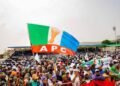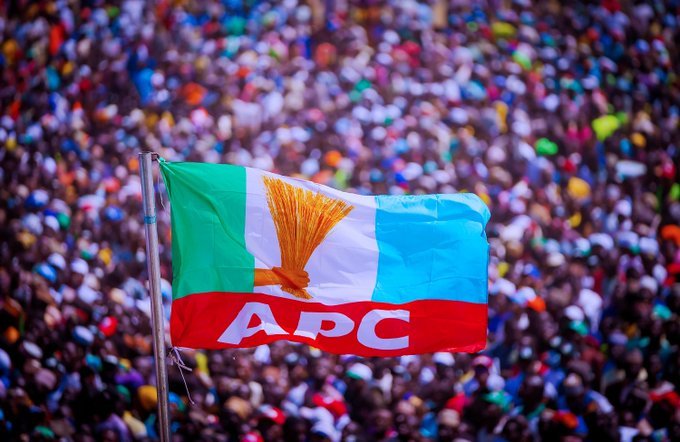
The United States chapter of the All Progressives Congress (APC) has requested to appear before the US House Subcommittee on Africa today, Thursday, as American lawmakers review former President Donald Trump’s decision to once again classify Nigeria as a “Country of Particular Concern” over claims of religious persecution.
In a letter to the Subcommittee Chairman, Rep. Chris Smith, APC USA said it was ready to send a senior delegation to present what it described as “firsthand intelligence and verifiable data” on the true nature of Nigeria’s security challenges.
The request was confirmed by APC USA Chairman, Prof. Tai Balofin, in a statement released in Abuja. He said the group aimed to correct what it considers misunderstandings surrounding insecurity in Nigeria.
“We support religious freedom for all Nigerians, but narratives abroad often fail to reflect the full complexity of the crisis,” Balofin said. “The insecurity in Nigeria is driven by banditry, resource conflict, climate pressures and transnational crime-not solely by religious persecution. Congress deserves the complete picture before reaching conclusions.”
Balofin added that APC USA’s testimony would also outline what it views as improvements achieved under President Bola Tinubu’s administration. He highlighted progress in reducing terrorist operations, enhancements to early-warning systems, and expanded interfaith cooperation, drawing on reports from both Nigerian authorities and global monitoring bodies.
The delegation is also expected to urge deeper US–Nigeria collaboration in areas such as security, intelligence sharing and humanitarian assistance.
“Chairman Chris Smith has long championed human rights and religious liberty,” Balofin said. “We respectfully ask him to grant APC USA the opportunity to contribute to a fair, accurate and solution-driven discussion.”
This request follows Nigeria’s criticism of the United States for excluding it from a UN programme hosted by American rapper Nicki Minaj, which centred on claims of targeted killings of Nigerians from a specific religious community.
Nigeria’s chargé d’affaires to the UN, Syndoph Endoni, condemned the exclusion, arguing that it was like “shaving our head in our absence.”
“It is important that the country at the centre of such allegations is present and has a voice,” Endoni said. He noted that US officials explained that the organisers wanted the event “private” due to concerns about reprisals against participants.
Endoni warned that one-sided actions could heighten tensions and said inclusive engagement was essential for real progress.
The US House Subcommittee on Africa is scheduled to meet at 11 a.m. today in Room 2172 of the Rayburn House Office Building to examine Nigeria’s CPC redesignation. The proceedings will be broadcast live.
If the designation is upheld, it may lead to sanctions against Nigerian officials accused of violating religious freedom and could limit certain forms of US assistance.
Expected witnesses include senior US State Department officials Jonathan Pratt and Jacob McGee; the Director of the Center for Religious Freedom, Nina Shea; Bishop Wilfred Anagbe of the Makurdi Catholic Diocese; and Oge Onubogu of the Center for Strategic & International Studies.
The hearing will explore the scale of religious persecution in Nigeria and the policy options available, including sanctions and humanitarian responses.
Trump’s Claim and Nigeria’s Response
On 31 October 2025, former President Donald Trump redesignated Nigeria as a CPC, arguing that Christians in the country face intense and targeted persecution. Trump claimed “thousands” had been killed and warned that the US could end aid or even consider military involvement if Nigeria did not act.
“If the Nigerian government continues to allow the killing of Christians, the USA will immediately stop all aid and may very well go into that now-disgraced country ‘guns-a-blazing,’” Trump said in a statement on 1 November.
President Bola Tinubu immediately dismissed the claims.
“Nigeria stands firmly as a democracy governed by constitutional guarantees of religious liberty,” Tinubu said on X. “The characterisation of Nigeria as religiously intolerant does not reflect our national reality. Religious freedom and tolerance remain core to our identity.”
Nigeria has consistently argued that its security problems are driven by criminal activity, economic hardship and environmental pressures, not state-backed religious persecution.
The outcome of today’s hearing may shape future relations between the US and Nigeria, depending on whether lawmakers choose to uphold or reconsider the CPC designation.