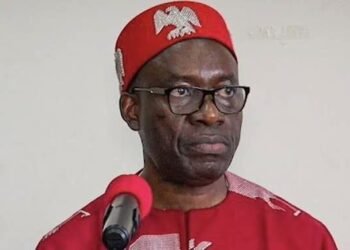
The newly appointed Chairman of the Independent National Electoral Commission, Professor Joash Amupitan, on Thursday, revealed plans to carry out an extensive audit of the commission, focusing particularly on the logistics used during the 2023 general elections.
According to Amupitan, the audit aims to identify the challenges encountered by the electoral body and to devise practical solutions in partnership with relevant stakeholders.
During his screening before the Senate Committee of the Whole, the Professor of Law presented a comprehensive reform plan that includes creating an internal ethics committee, introducing a whistleblower policy, ensuring strict accountability, and adopting advanced technology — including drones — to improve election logistics and security operations.
Citing a ruling by the Supreme Court, Amupitan pointed out that INEC’s Results Viewing Portal was not part of the commission’s official results collation process, adding that this information had not been clearly communicated to the public before the 2023 general elections.
Amupitan emphasised that, if confirmed as INEC chairman, his administration would be founded on trust and ethical principles.
“I think that trust is a major concern. We will work out an internal mechanism to try the behaviour of humans,” he said.
“I’m taking this position on trust, and my people must also appreciate that they hold their positions on trust. We will set up an ethical committee to review what has happened in the past because complaints have been made, yet no action has been taken. We will pursue every complaint and follow through,” he added.
Amupitan also disclosed that he would collaborate with the National Assembly to establish an Electoral Offences Commission to ensure proper investigation and prosecution of electoral crimes.
He noted that INEC currently lacks the institutional capacity to investigate and prosecute electoral offences and announced plans to introduce a whistleblowing framework.
“We will collaborate with the National Assembly because legislative intervention is necessary for the creation of an electoral offences commission that can investigate cases, even through forensic means. We will also introduce a whistleblowing policy to expose such practices,” he said.
Regarding election security, Amupitan pledged to implement innovative strategies to guarantee that no eligible voter is denied participation, including those in remote locations.
“Security is a major challenge. We will work with the security committee to strengthen those areas. We will invest in logistics to ensure we reach every part of Nigeria — even if we need to use drones. No voter will be left behind; that will be our policy,” he stated.
Amupitan also underscored the need to promote voter and civic education as part of efforts to strengthen democracy.
“There’s going to be voter and civic education. We will build the capacity of all election stakeholders and embark on aggressive civic enlightenment,” he said.
Speaking on the controversial issue of real-time result transmission, Amupitan explained that legal clarity was required to address the existing inconsistencies in the Electoral Act.
“On the issue of real-time transmission, the Electoral Act has not been concluded. I will make my input where necessary to ensure the matter is properly addressed,” he assured.
The INEC chairman further promised to harmonise election timelines and procedures to promote transparency and credibility.
“The issue of the timeline will be streamlined to remove ambiguities. We will ensure elections are credible so that losers can congratulate winners without dispute. We will also prioritise the security of election materials,” he stated.
Amupitan also committed to enforcing strict transparency in the commission’s financial operations.
“This parliament has sufficient laws on procurement and public fund management, and they will be enforced strictly to ensure funds are utilised for their intended purposes. We will also save costs where possible,” he said.