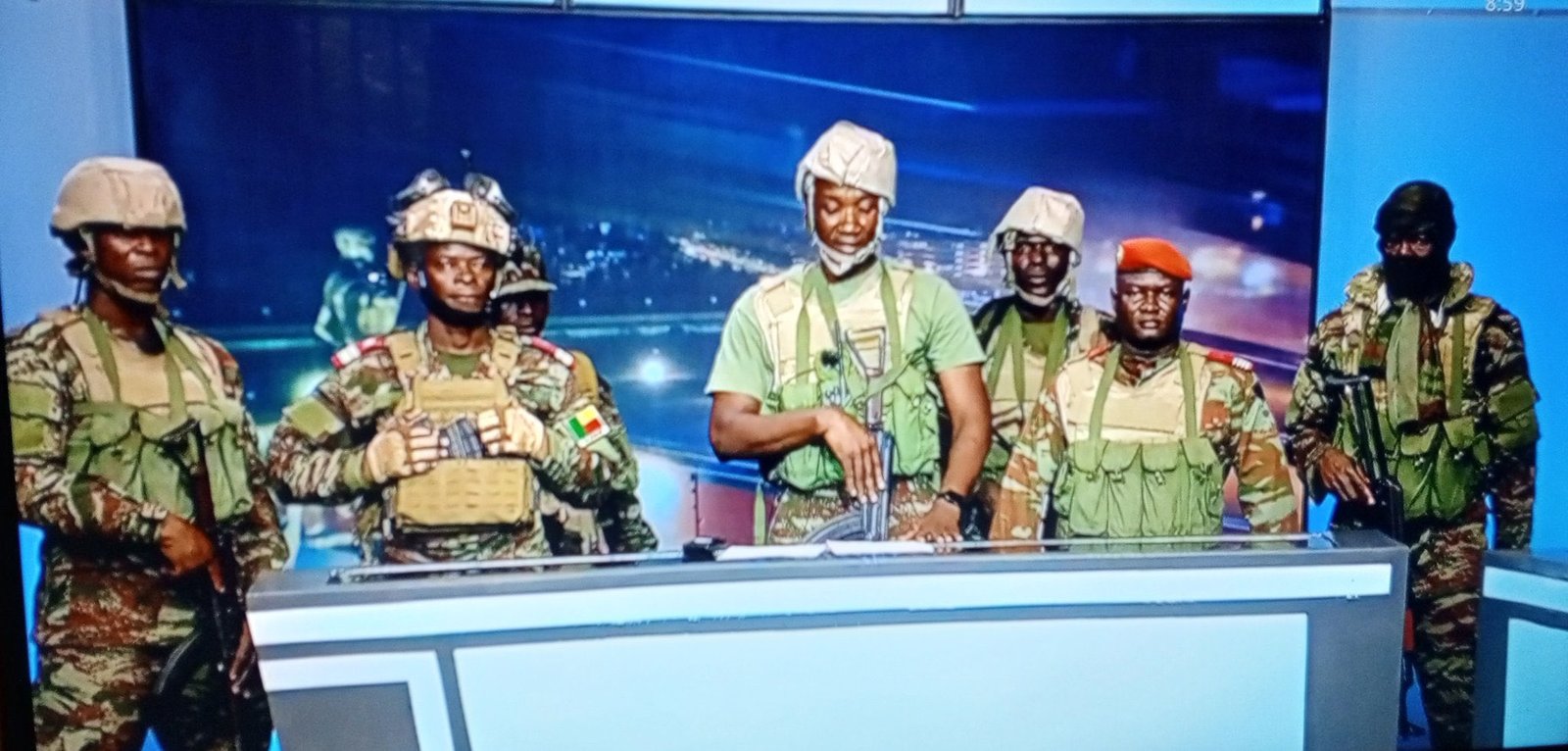
Tension swept through Benin on Sunday after a group of soldiers disrupted national broadcasts and announced the collapse of the country’s civilian government, sparking fears of a military takeover.
The officers, operating under the name Military Committee for Refoundation, named Lieutenant Colonel Pascal Tigri as their leader. During the televised address, Tigri proclaimed himself head of a military re-establishment committee and declared that President Patrice Talon had been removed from office and all state institutions dissolved.
Beninese media reports said the soldiers had earlier targeted the president’s residence in the Le Guézo district before moving to occupy the national television station to push out their message.
The presidency, however, swiftly debunked the claims, confirming that President Talon was unharmed and remained in a secure location. According to officials, loyal troops immediately moved into action to contain the situation and reclaim strategic points in the capital.
This is a small group of people who only control the television. The regular army is regaining control. The city and the country are completely secure.
The government’s response made it clear that the attempted takeover lacked the support of the wider military command.
The scare in Benin comes at a time when West Africa is already grappling with repeated military interventions and stalled democratic transitions. Guinea-Bissau slipped into crisis in November 2025 after soldiers seized power on the eve of a presidential election, arresting President Umaro Sissoco Embaló and installing General Horta Inta-A as interim leader. The move was widely condemned by ECOWAS, while opposition candidate Fernando Dias da Costa fled to Nigeria over safety concerns.
In Mali, military rule has dragged on since the back-to-back coups of 2020 and 2021 that brought Colonel Assimi Goïta to power. A fresh coup plot was uncovered in August 2025, leading to the arrest of two generals and a French national. Political activities remain restricted, elections are still uncertain, and jihadist violence continues to undermine security.
Burkina Faso has followed a similar path since Captain Ibrahim Traoré seized power in 2022. An alleged coup attempt in April 2025 prompted heightened security measures after authorities accused senior officers of colluding with terrorist groups. The junta has postponed elections and rolled out controversial measures, including moves to reintroduce the death penalty for treason and terrorism.
Niger also remains under military control following the July 2023 overthrow of President Mohamed Bazoum by his presidential guards. General Abdourahamane Tchiani emerged as leader, and despite regional sanctions and diplomatic pressure, the junta still holds power, with public opinion in Niamey deeply divided.
Against this backdrop, the failed attempt in Benin has intensified regional concerns about democratic stability and the growing influence of military actors across West Africa.