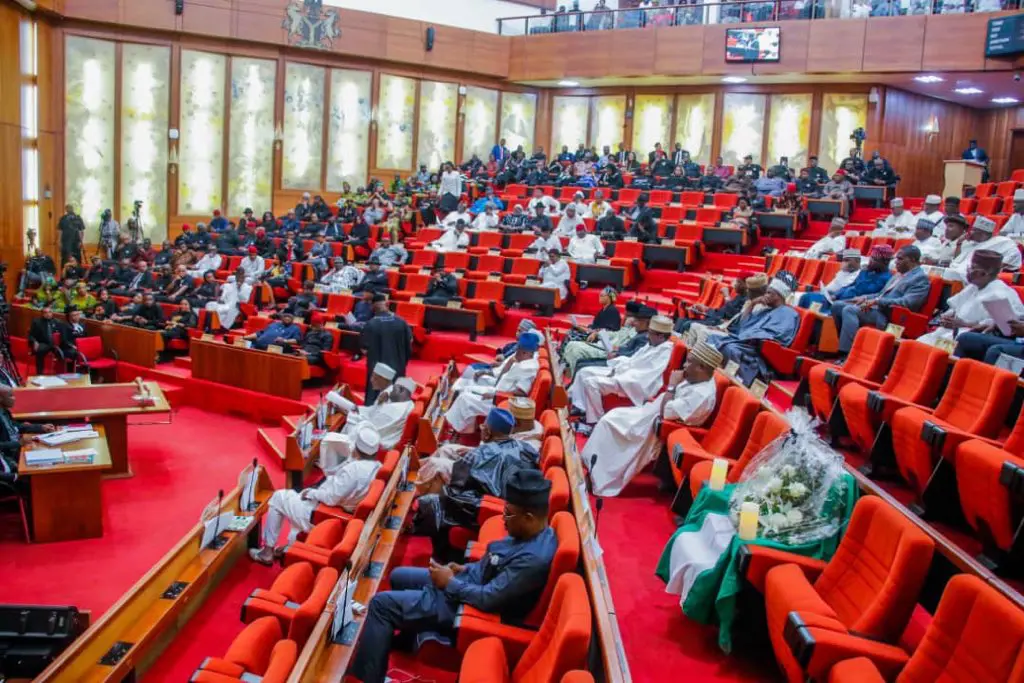
The Senate has launched an investigation into the widespread, scientifically confirmed lead poisoning crisis affecting Ogijo, a heavily populated community on the border of Ogun and Lagos States.
In reaction to the alarming situation, the Senate summoned the Ministers of Environment, Health, Solid Minerals, Labour and Employment, along with the Director General of the National Environmental Standards and Regulations Enforcement Agency, to appear before the Senate Committee on Environment and Solid Minerals for a full briefing.
The Senate linked the disaster to several used lead-acid battery recycling factories, which have created a severe public health emergency. Children, women, and factory workers are said to be suffering life-changing health complications after years of exposure to toxic emissions.
To address the crisis, the Senate approved urgent steps, including emergency medical intervention and environmental cleanup.
The Upper Chamber also called on the Nigeria Centre for Disease Control and Prevention to deploy emergency medical teams for free toxicology screening, blood-lead tests, chelation therapy, and long-term treatment for victims.
Additionally, it ordered a full environmental remediation programme by the Federal Ministry of Environment and NESREA to assess soil, groundwater, air, and household dust contamination.
The Senate further pushed for the establishment of a National Lead Poisoning Response and Remediation Office under the National Emergency Management Agency to oversee cleanup efforts, medical treatment, monitoring, and tracking of exported lead.
It directed the Senate Committee on Legislative Compliance to ensure full implementation of all resolutions within six weeks.
These resolutions followed a motion sponsored by Senator Adetokunbo Abiru (Lagos East) and Senator Gbenga Daniel (Ogun East), who warned that Ogijo is now facing “an environmental catastrophe of global significance,” with contamination levels recorded at 186 times above global safety limits.
In his remarks, Senator Abiru expressed concern over long-standing reports of persistent headaches, abdominal pain, seizures, memory loss, and cognitive decline — symptoms strongly connected to extended lead exposure — which residents have suffered for years without meaningful intervention.
Following the debate, Senate President Godswill Akpabio instructed the Committee on Legislative Compliance to track progress and provide a report within two months.