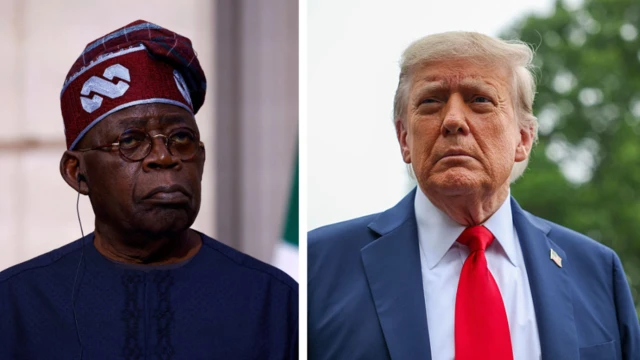
Twelve northern governors, senior traditional rulers and high-ranking judges are at the centre of a potential diplomatic crisis as the United States Congress considers a bill that could impose sweeping sanctions on them over alleged complicity in what American legislators call a “Christian genocide” and systemic persecution tied to Nigeria’s sharia and blasphemy laws.
The development follows President Donald Trump’s redesignation of Nigeria as a Country of Particular Concern and his instruction to Secretary of State Marco Rubio to act quickly.
On Friday, Mr Trump, in a post on Truth, said thousands of Christians were being killed in Nigeria and asked Congressman Riley Moore and House Appropriations Chair Tom Cole to examine the matter and report back to him.
The Nigeria Religious Freedom Accountability Act of 2025, introduced by Republican Senator Ted Cruz, seeks to designate Nigeria as a “Country of Particular Concern” for religious persecution.
The bill would authorise targeted penalties against public officials and religious figures accused of promoting or tolerating violence directed at Christians and other religious minorities.
In December 2020 the US Department of State first listed Nigeria as a Country of Particular Concern, citing systematic, ongoing and egregious violations of religious freedom, cyclical Boko Haram violence and frequent ethno-religious conflicts compounded by deficiencies in the judicial system.
Under the 2025 bill, introduced on 9 September 2025, the US Secretary of State would have 90 days after passage to submit to Congress a list of Nigerian officials — including governors, judges and traditional rulers — who have “promoted, enacted, or maintained blasphemy laws” or who have “tolerated violence by non-state actors invoking religious justification.”
Sanctions would be imposed under Executive Order 13818, using the Global Magnitsky Human Rights Accountability framework, and could include visa bans, asset freezes and other financial restrictions on those judged culpable.
A central focus of the bill is the criminal application of Sharia in northern Nigeria, which supporters of the legislation describe as blasphemy law that discriminates against Christians.
Sharia — derived from Islamic jurisprudence — has long regulated personal, moral and community life among Muslim communities in northern Nigeria.
A major shift occurred between 1999 and 2000, shortly after Nigeria’s return to civilian rule, when several northern states, beginning with Zamfara under Governor Ahmad Sani Yerima, extended Sharia to cover criminal matters and public morality.
Within two years roughly 12 northern states had adopted similar Sharia penal codes and set up parallel Sharia courts alongside the secular courts.
The states affected include Zamfara, Kano, Sokoto, Katsina, Bauchi, Borno, Jigawa, Kebbi, Yobe, Kaduna, Niger and Gombe.
By contrast, states such as Kwara, Kogi, Plateau, Benue, Nasarawa, Taraba and Adamawa — though home to substantial Muslim populations — retain a conventional secular legal framework, with Sharia limited to personal status matters (marriage, inheritance and family law) for Muslims rather than criminal or public law.
Recently the Sharia Council announced plans to establish a presence in southern areas, beginning with Oyo and Ogun States.
That proposal provoked tensions between Christian and Muslim groups who feared the expansion of Sharia, though the council later clarified that it planned to set up arbitration panels, not courts, to mediate Muslim-related disputes and provide non-binding advice.
Defending the bill, Senator Cruz said Nigeria’s leaders had “institutionalised sharia law and enabled jihadist violence.” He added: “Religious persecution and violence against Christians and other religious minorities in Nigeria is endemic. Since 2009, over 52,000 Christians have been murdered, 20,000 churches and faith institutions destroyed, and dozens of villages wiped out. The federal and state governments have failed to act, and in many cases, they are complicit.”
The bill notes that since the adoption of Sharia in Zamfara in 2000, many northern states incorporated blasphemy provisions into their codes. States such as Kano, Bauchi, Sokoto and Katsina have drawn international condemnation for death sentences handed down for alleged blasphemy; even southern areas with Sharia panels, like Oyo and Ogun, may face scrutiny.
FG defends Sharia
The Federal Government has defended the country’s constitutional and legal arrangements on religious freedom, arguing that Nigeria neither enforces a nationwide blasphemy law nor persecutes Christians as the draft US legislation claims.
In an official policy note titled “Nigeria’s Constitutional Commitment to Religious Freedom and Rule of Law,” the Ministry of Foreign Affairs said that Nigeria’s constitution and judicial system protect freedom of religion and conscience, and that state and local laws — including Sharia provisions — are subject to constitutional safeguards and secular appellate review.
The statement stressed that Nigeria remains a constitutional, multi-religious democracy; the 1999 Constitution (as amended) forbids a state religion (Section 10), guarantees freedom of thought, conscience and religion (Section 38), and prohibits discrimination on grounds including religion (Section 42).
“Sharia in Nigeria is not a nationwide, compulsory system,” the document said.
It explained that certain northern states have enacted Sharia-based criminal provisions that apply only to persons who profess Islam; non-Muslims are not subject to those measures.
“In civil or personal matters, such as marriage or inheritance, recourse to Sharia is elective, just as parties may choose customary or statutory regimes,” the note added.
The Federal Government further emphasised that there is no federal offence of blasphemy in Nigerian law, and that national criminal statutes address public-order offences or acts likely to provoke violence in a religion-neutral way.
“The government of Nigeria does not persecute Christians, in law or policy,” the statement said. “Nigeria’s legal order protects all faiths equally; Christians freely build and register churches, run schools and charities, and hold public office across the Federation.”
It reiterated that Sharia’s scope is constitutionally limited and optional. In civil matters Sharia Courts of Appeal at state and federal levels have jurisdiction only over Islamic personal law where parties voluntarily elect that system; in criminal matters, only a handful of northern states have adopted Sharia-based codes and jurisdiction remains confined to Muslims. Non-Muslims cannot be tried under those laws.
“Even where a first-instance Sharia court enters a conviction, constitutional due-process standards — fair hearing, legal representation and proof thresholds — apply. Secular appellate courts have repeatedly set aside or remitted convictions where procedures or rights were deficient. Sharia adjudication is bounded by the constitution, not above it,” the government explained.
The note dismissed claims that Nigeria’s laws or policies tolerate religious discrimination. “Nothing in Nigeria’s Constitution, Criminal Code, or Penal Code authorises persecution of Christians or adherents of any religion,” it said.
It also described some provisions abroad labelled “blasphemy laws” as content-neutral public-order offences intended to prevent inter-communal violence. The statement pointed out that Christian denominations and NGOs operate freely nationwide and that Christians participate at all levels of government and the judiciary.
Responding to allegations that Nigeria “tolerates” religion-motivated violence by non-state actors, the government highlighted its counter-terrorism efforts. “Boko Haram and ISWAP remain proscribed under the Terrorism (Prevention) Act, with thousands of arrests, prosecutions and deradicalisation programmes underway,” it said.
The government argued many attacks characterised abroad as religiously motivated are in fact driven by terrorism, organised crime, resource conflicts and climate stress, and noted that federal and state authorities deploy joint operations without bias. Nigerian authorities, the note said, consistently condemn sectarian violence, investigate incidents and prosecute offenders where evidence warrants.
Nigeria reaffirmed its commitment to international human-rights instruments such as the International Covenant on Civil and Political Rights and the African Charter on Human and Peoples’ Rights, which are domesticated and enforceable in domestic courts. It insisted that all domestic laws must conform to constitutional guarantees and pointed to court judgments as proof.
The government criticised the US draft legislation as “legally and factually flawed,” arguing it conflates distinct legal regimes — federal law, state statutes and Sharia — into a single, inaccurate picture and wrongly equates neutral public-order provisions with theological blasphemy.
Concerns raised
Nevertheless, the use of Sharia has prompted human-rights and religious-freedom concerns, including reported restrictions on non-Muslims’ worship, limits on church construction and curbs on the celebration of traditional festivals.
Converts from Islam to Christianity and other faiths have complained of harassment and violence, while vaguely worded blasphemy provisions can be applied arbitrarily, enabling mobs to act violently and sometimes lethally.
Public outrage followed several high-profile mob killings: Deborah Samuel, a second-year student at Shehu Shagari College of Education, Sokoto, was lynched and burned in May 2022 after accusations of blasphemy; the perpetrators were not brought to justice. Usman Buda, a butcher in Sokoto, was similarly lynched after blasphemy allegations; in 2021 a water seller in Bauchi was beaten and burned to death for alleged blasphemy; and in 2016 Bridget Agbahime, aged 74, was beaten to death in Kano after being accused of blaspheming the Prophet.
Trump’s warning and possible US action
In designating Nigeria a “Country of Particular Concern,” Mr Trump said there are severe violations of religious freedom and claimed Christianity faces an existential threat in Nigeria, alleging thousands of Christians have been killed by radical Islamists. He warned the US could act — including possible military action — if Nigeria failed to stop the violence.
Mr Trump said the US might halt all aid to Nigeria should the Tinubu administration fail to halt the alleged persecution and killings. He declared: “If the Nigerian Government continues to allow the killing of Christians, the USA will immediately stop all aid and assistance to Nigeria, and may very well go into that now disgraced country, ‘guns-a-blazing,’ to completely wipe out the Islamic terrorists who are committing these horrible atrocities. ‘I am hereby instructing our Department of War to prepare for possible action. If we attack, it will be fast, vicious, and sweet, just like the terrorist thugs attack our CHERISHED Christians,’” he said.
If enacted, the Act would compel the US to impose targeted sanctions on officials enforcing Sharia or blasphemy provisions, to blacklist Nigerian actors complicit in religion-motivated violence, and to retain terror designations for Boko Haram and ISIS-West Africa as Entities of Particular Concern.
Echoing Mr Trump’s invasion threat, US Secretary of War Pete Hegseth said in an X post that the Department of War is preparing for action if Nigeria does not protect Christians. “The killing of innocent Christians in Nigeria — and anywhere — must end immediately. The Department of War is preparing for action. Either the Nigerian Government protects Christians, or we will kill the Islamic Terrorists who are committing these horrible atrocities,” he wrote.
Under Section 3 of the draft — “Designations and amendments related to the International Religious Freedom Act” — the US Secretary of State would be instructed to “Designate, for engaging in or tolerating systematic, ongoing, and egregious violations of religious freedom — (1) the Federal Republic of Nigeria as a Country of Particular Concern; and (2) Boko Haram and ISIS-West Africa as Entities of Particular Concern.” The designation draws on section 402(b)(1)(A) of the International Religious Freedom Act of 1998 and section 301(a) of the Frank R. Wolf International Religious Freedom Act of 2016.
Tinubu-US meeting planned
In response, the Presidency said President Bola Tinubu would meet his American counterpart in the coming days to discuss the allegations of a Christian genocide in Nigeria. Daniel Bwala, Special Adviser to the President on Policy Communication, said on X that the planned meeting would prioritise counter-terrorism cooperation and clarifying misconceptions about the nature of attacks in Nigeria.
“Both President @officialABAT and President @realDonaldTrump have shared interests in the fight against insurgency and all forms of terrorism against humanity,” Bwala wrote. “President Trump has assisted Nigeria a lot by authorising the sale of arms, and President Tinubu has adequately utilised that opportunity in the fight against terrorism, with massive results to show for it. As for the differences as to whether terrorists in Nigeria target only Christians or all faiths, those would be discussed and resolved by the two leaders when they meet in the coming days, either in the State House or White House.”
Bayo Onanuga, the President’s Special Adviser on Information and Strategy, said the President had anticipated and responded to what he described as “orchestrated moves” to damage Nigeria’s image overseas and reiterated the government’s focus on national security. He quoted Mr Tinubu’s recent remarks to the new service chiefs warning that the military must be decisive and that Nigerians expect results, not excuses. Mr Tinubu highlighted the emergence of new armed groups in the North-Central, North-West and parts of the South and urged the military to “smash the new snakes right in the head.”
SaharaReporters said Mr Trump had “delegated his Vice, James David Vance, to meet with Tinubu during the visit,” subject to change, and reported Mr Tinubu’s planned trip to the United States for high-level diplomatic talks.
Envoys, analysts voice concern
Retired diplomats and foreign-policy experts warned the CPC designation could have wide consequences for diplomatic ties, security cooperation and economic development. A former Nigerian ambassador to Algeria and Portugal, Mohammed Mabdul, said the move could curtail US aid for socio-economic programmes such as health, education, microfinance and gender initiatives. He added that visa restrictions were already being applied and that security cooperation could be affected, noting Nigeria depends on US supplies of advanced military hardware in the fight against terrorists.
Ogbole Amedu-Ode, a former Ministry of Foreign Affairs spokesman, said the episode should be a wake-up call for the government to better protect lives and property. He warned of likely economic and political fallout, including reduced Western investment and possible isolation in international bodies, while suggesting that emerging economies might fill any void. He urged prompt posting of ambassadors and consuls to safeguard Nigeria’s diplomatic presence.
Retired Ambassador Godknows Igali urged diplomacy and the use of friendly third countries to mediate, warning that major powers often pursue their own strategic aims and advising caution in engagement with the US administration, which he described as having “very strong views.”
Foreign-affairs analyst Charles Onunaiju said the move was not unprecedented and reflected a longstanding hostile posture by the Trump administration. He warned the designation could deter investors and urged the Federal Government not to respond with bombast but to set out the facts and push internal reforms. He described the development as a “wake-up call” with “broad implications.”
Calls for help not confrontation
Former Kano Governor and NNPP presidential candidate Senator Rabi’u Kwankwaso urged the US to provide advanced technology and intelligence support rather than threats that might polarise Nigeria. He also called on the Federal Government to appoint senior diplomats to engage directly with Washington and to fill key ambassadorial posts. Kwankwaso appealed for national unity.
A youth group, the National Youth Council of Nigeria (NYCN), condemned the US President’s threat of war as an abomination.
Religious bodies react
The Christian Association of Nigeria blamed a lack of courage among Nigeria’s leaders to tackle killings and human-rights violations for creating the conditions that prompted Mr Trump’s intervention. Northern CAN chairman Rev John Hayab told The PUNCH that Mr Trump’s warning presented an opportunity for the Federal Government to act decisively against those who violate citizens’ rights under the guise of religion. Hayab said Mr Trump was urging the government to “take action” to stop the killings and suggested the US would not deploy troops but was calling for corrective measures.
The Muslim Rights Concern said Mr Trump’s threat should be interpreted as directed at terrorist organisations rather than at Nigeria or its Muslim population. MURIC’s executive director Professor Ishaq Akintola stressed that any US strike would be justified only if it targeted terrorist groups such as Boko Haram, ISIS and ISWAP, which have killed both Muslims and Christians. He warned that strikes hitting civilians or places of worship would be hostile and tantamount to religious aggression, and urged calm and adherence to diplomatic channels.
Sultan criticised, responds
A former US mayor, Mike Arnold, publicly criticised the Sultan of Sokoto, Alhaji Sa’ad Abubakar, accusing him of failing to use his influence to curb jihadist violence and linking the Sultan’s earlier posting in Pakistan to the later spread of jihadist tactics in northern Nigeria. The Sultanate Council said the Sultan would not dignify such allegations with a reply, affirming its focus on peaceful coexistence.
Political warning
PDP chieftain Segun Showunmi urged the government to prevent the US from invoking both the CPC designation and the Global Magnitsky Act, warning their combined force could damage Nigeria’s reputation and target individuals. “The @NigeriaGov must do everything humanly possible to avoid the invocation of a Global Magnitsky Act,” he said, noting that the CPC targets the state while Magnitsky targets individuals. He warned that Western allies may not shield Nigeria should the US proceed.
Showunmi recalled that the Global Magnitsky Act was designed to hold human-rights abusers and corrupt officials personally accountable through coordinated global measures.