Nigeria’s top government officials have strongly dismissed United States President Donald Trump’s claim that Christians are being deliberately killed in Nigeria, calling it false, misleading, and based on foreign propaganda.
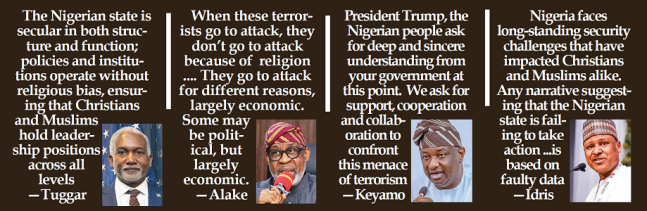
At a series of press briefings and meetings in Abuja, several ministers, including Mohammed Idris (Information), Oladele Alake (Solid Minerals), Yusuf Tuggar (Foreign Affairs), and Festus Keyamo (Aviation), defended Nigeria’s record on religious freedom. They stressed that terrorism and insecurity in the country affect both Christians and Muslims equally.
Prominent Nigerians, including human rights lawyer Femi Falana (SAN) and former senator Ita Enang, also criticised the claim, describing it as a product of misinformation by foreign lobbyists.
Minister of Information Mohammed Idris said that the government has traced the negative narrative to foreign actors linked with local agitators. He stated that Nigeria remains a model of “religious plurality and democratic endurance,” adding that the current administration has “neutralised over 13,500 terrorists” and arrested more than 17,000 suspects since May 2023.
He further revealed that more than 9,800 abducted victims have been reunited with their families within the same period. According to Idris, the United States’ position on Nigeria is driven by “misrepresentation and misinformation.”
Foreign Affairs Minister Yusuf Tuggar, represented by Ambassador Dunoma Ahmed, told diplomats that Nigeria’s security issues have no religious colouration. He described the country as a secular state with a constitutional guarantee of freedom of religion, stressing that the Nigerian legal system protects all faiths equally.
He also said that major military operations such as Operation Hadin Kai and Operation Lake Sanity have reclaimed territories from Boko Haram and ISWAP and enabled displaced citizens to return home. Tuggar warned that branding Nigeria as a “Country of Particular Concern” over alleged Christian persecution is “fundamentally misinformed.”
According to him, Nigeria’s nearly equal population of Christians and Muslims, its secular institutions, and its functioning democracy prove that the country promotes coexistence, not division.
Minister of Solid Minerals Oladele Alake added that insecurity in Nigeria has dropped to its lowest level in a decade, thanks to strategic security reforms and new leadership across security agencies. He warned against portraying attacks as religious, saying that most are driven by political and economic motives.
Alake urged the media to be more responsible in their reporting to avoid fuelling division, stating, “If there is no society, there is no press.”
Aviation Minister Festus Keyamo, in an open letter to President Trump, condemned the claim of mass killings of Christians, calling it “false and irresponsible.” He said as a Christian himself, he could never serve in a government that persecutes Christians.
Keyamo highlighted his three decades of human rights advocacy and insisted that Nigeria’s security challenges—whether from Boko Haram, bandits, or herdsmen—affect both Christians and Muslims equally.
He emphasised that President Bola Tinubu is a “moderate Muslim” married to a pastor, adding that the administration is tackling insecurity without bias. He appealed to President Trump and the U.S. government to work with Nigeria in addressing terrorism instead of spreading false narratives.
Falana also rejected the allegation, saying, “Mr Trump has lied to the whole world by alleging Christian killings in Nigeria without any evidence.” He urged the government to focus on tackling the root causes of violence rather than reacting emotionally.
United Nations envoy Dr Mohammed Chambas, while speaking at a conference in Abuja, attributed violent extremism in West Africa to lack of dialogue and social interaction among communities. He warned that the Sahel now accounts for over half of global terrorism-related deaths and called for stronger community-based peace education.
ECOWAS Commissioner for Peace and Security, Dr Abdel-Fatau Musah, urged Islamic organisations to help re-educate the youth against extremist ideologies.
Former presidential adviser Senator Ita Enang, meanwhile, urged the Nigerian government to present a unified diplomatic response to the U.S., cautioning against uncoordinated statements that could misrepresent Nigeria’s official position.
He advised that the Presidency, Ministry of Foreign Affairs, National Intelligence Agency (NIA), and National Assembly leadership should issue a coordinated response, stressing that the matter must be handled “with utmost caution.”