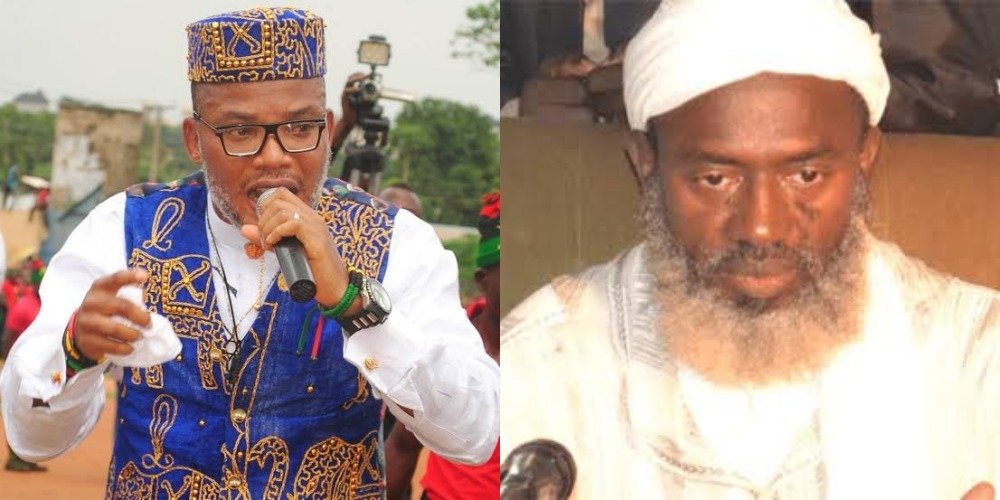
A lawyer and political commentator, Malcolm Emokiniovo Omirhobo, has said the life sentence handed to the Indigenous People of Biafra (IPOB) leader, Mazi Nnamdi Kanu, has exposed what he described as a troubling two-track justice system in Nigeria—one that swiftly punishes some citizens while protecting others who openly commit worse offences.
Omirhobo argued that while Nnamdi Kanu has been arrested, detained, tried, and now convicted, Sheikh Ahmad Gumi continues moving freely despite openly associating with armed bandit groups. He said Gumi meets with terrorists, negotiates with them, defends their actions publicly, issues provocative statements, and presents himself as their spokesperson without ever being questioned by law enforcement.
He said the contrast is not just morally wrong but unconstitutional, pointing to Sections 17, 36, and 42 of the 1999 Constitution, which guarantee equality before the law, equal legal protection, and freedom from discriminatory enforcement.
In a statement he personally signed, Omirhobo said that Nigeria has reached a point where one citizen is prosecuted for speech, yet another who interacts directly with terrorists is described as a “mediator.”
According to him, “This is not the rule of law. This is ruled by selective discretion.
Nnamdi Kanu: accused of making inflammatory broadcasts; charged, tried, and convicted; arrested through extraordinary rendition; denied consistent access to justice for years.
“Sheikh Ahmad Gumi: Enters terrorist camps freely; meets armed criminals responsible for mass killings and kidnappings; publicly defends them; undermines national security repeatedly. ZERO arrest. ZERO prosecution. ZERO accountability.”
He argued that if verbal broadcasts qualify as terrorism, then direct contact, negotiation, and public advocacy for armed groups should be considered far more serious crimes. He said Nigeria cannot claim to be fighting terrorism while allowing individuals who openly engage with terrorists to operate freely.
Omirhobo added that justice must not only be done but must be seen to be done, insisting this is not the case in the current situation.
He called on the Federal Government, the Attorney-General of the Federation, the Department of State Services (DSS), and the Nigeria Police Force to enforce the law equally on all citizens, regardless of ethnicity, religion, region, or political interest.
He demanded an investigation into Sheikh Ahmad Gumi’s open interactions with terror groups, saying the culture of selective prosecution must end to restore public trust in the justice system.
According to him, no country can claim to be fighting insecurity while shielding individuals who associate with those causing nationwide suffering. He described the conviction of Nnamdi Kanu while Gumi remains untouched as a clear example of a double standard.
He concluded that unless the Nigerian state shows that the law applies equally to everyone, its battle against insecurity will remain weakened. He said justice must be equal, justice must be consistent, and justice must be blind, noting that anything less amounts to injustice.