

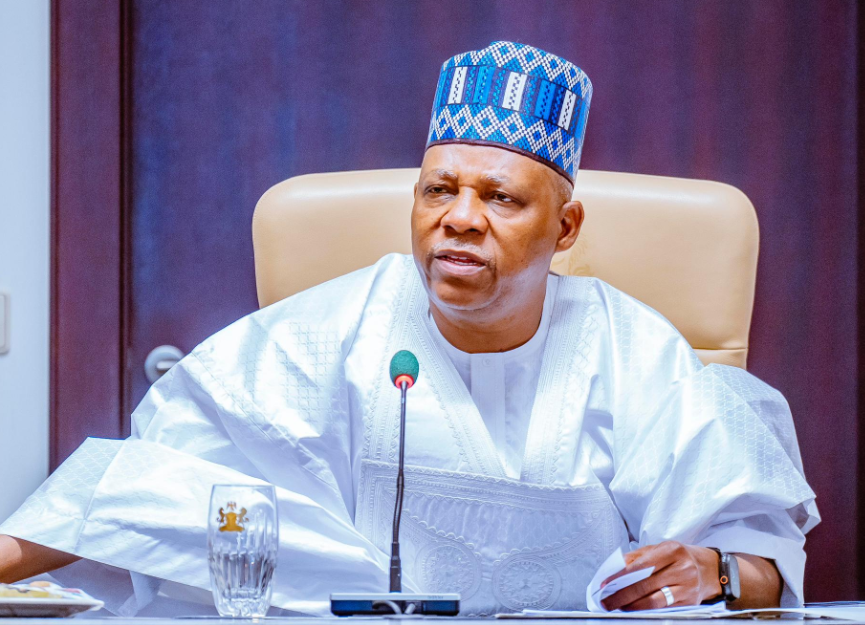
Vice President Kashim Shettima has said that the days of instability and unpredictability in Nigeria’s economy are over, crediting President Bola Tinubu’s ongoing reforms for restoring investor confidence and macroeconomic balance.
Speaking in Abuja at the opening of the Digital Nigeria International Conference and Exhibition, Shettima stated that the current administration has taken bold steps to address global economic challenges marked by “shocks, shifting alliances, and the rapid displacement of traditional jobs by emerging technologies.”
He noted that the reforms are already yielding positive outcomes, citing recent upgrades by international rating agencies as proof of Nigeria’s improving financial health.
According to a statement by Stanley Nkwocha, the Vice President’s Senior Special Assistant on Media and Communications, Shettima said: “Fitch’s upgrade of Nigeria’s sovereign rating to B with a stable outlook, and Moody’s lifting of our issuer rating to B3, are clear signals that the world is taking note of the steady course we are maintaining. What this administration has achieved is to end the regimes of volatility and unpredictability that once defined our economy.”
He added that the next phase is to ensure that these macroeconomic gains “trickle down to the people—from the kiosks of neighbourhood traders to the boardrooms of multinational corporations.”
The Vice President emphasised that the government’s economic strategies are based on the understanding that “we can no longer apply 20th-century solutions to 21st-century problems.”
Shettima also highlighted that the conference theme, Innovation for a Sustainable Digital Future: Accelerating Growth, Inclusion, and Global Competitiveness, aligns perfectly with President Tinubu’s broader economic reform agenda.
He said Nigeria’s long-term stability depends on embracing digital transformation and prioritising deep-tech solutions that tackle issues in agriculture, healthcare, logistics, and governance.
“We need a digital ecosystem that works as seamlessly in Lagos as it does in Abuja, Port Harcourt, Kano, Gusau, and across every corner of our nation,” he said.
Painting a vision of inclusivity, Shettima said the goal is to create a digital economy where “a farmer in Bida can access real-time market data to sell his harvest at a fair price” and “a young woman in Oguta can work remotely for a global company because she has the connectivity and skills to compete.”
He urged Nigeria to seize the “redemptive opportunity” of the digital revolution to define its global role, describing President Tinubu as “a man of a thousand visions” and a leader for a time that demands patriots and reformers.
Outlining the government’s digital strategy, Shettima identified three key pillars — people, infrastructure, and policy. He mentioned flagship initiatives such as Digital Literacy for All (DL4ALL) and the 3 Million Technical Talent (3MTT) programme as critical to human capacity development.
He also revealed that the National Digital Economy and e-Governance Bill is in its final legislative stage, and once passed, it will “unlock the GovTech revolution” to enable smarter governance, transparency, and inclusivity.
Shettima called for private sector collaboration, describing industry players as “the innovators, the disruptors, the dreamers who turn possibilities into progress.”
Minister of Communications, Innovation and Digital Economy, Dr Bosun Tijani, praised the administration’s digital policies for strengthening national infrastructure and urged stakeholders to deepen cooperation.
Similarly, NITDA Director-General Kashifu Inuwa Abdullahi commended Shettima for his commitment to youth-focused initiatives, while Nigeria Data Protection Commission CEO, Dr Vincent Olatunji, stressed that Nigeria must position itself strategically to harness the full benefits of its fast-growing digital economy.











Can you be more specific about the content of your article? After reading it, I still have some doubts. Hope you can help me. https://www.binance.com/kz/register?ref=K8NFKJBQ
Thank you for your sharing. I am worried that I lack creative ideas. It is your article that makes me full of hope. Thank you. But, I have a question, can you help me?